When data prefers a direction in state space
In many physical problems, directionality is introduced by hand: a force term, a potential, or an explicit equation of motion.
But sometimes direction emerges directly from the data.
When independent observations populate a narrow family of trajectories in an abstract state space, and these trajectories consistently point toward a specific region, the system exhibits a preferred direction — even without specifying underlying dynamics.
This is the language of attractors.
Attractors as data-driven structures
In dynamical systems, an attractor is not defined by a force, but by behavior:
- trajectories from different initial conditions converge,
- deviations decay rather than amplify,
- the system forgets its detailed past.
Crucially, an attractor can be identified without knowing the microscopic equations.
All that is required is a state-space description and sufficiently consistent trajectories.
From equations to diagnostics
Consider a system described by abstract state variables $(X, Y)$.
If the data trace trajectories that spiral inward toward a stable point, we infer:
\[\frac{dS}{dt} \propto -\nabla \Phi(S)\]without ever specifying what $\Phi$ is.
The direction is inferred empirically, not postulated.
This is fundamentally different from introducing a new force term.
A minimal illustration
The figure below shows a purely diagnostic example: a trajectory in state space approaching a stable attractor.
- No force law is assumed.
- No physical interpretation is attached to $X$ or $Y$.
- Only the structure matters.
What we see is:
- a preferred direction in state space,
- decay of excursions,
- convergence toward a stationary point.
That alone is enough to define an attractor.
Why this matters for cosmology (and beyond)
When late-time cosmological data form:
- smooth,
- coherent,
- sub-percent trajectories,
- consistent across probes,
the natural question is not “what force causes this?” but rather:
What structure in state space are the data revealing?
In this view, acceleration is not necessarily a source term — it may be the macroscopic signature of relaxation toward a stable state.
A note on interpretation
An attractor is not a claim about fundamental dynamics.
It is a statement about organization.
Just as entropy increase defines an arrow of time without invoking a new interaction, a preferred direction in data-defined state space does not require a new force.
It requires only consistency.
Figure: trajectory approaching a state-space attractor
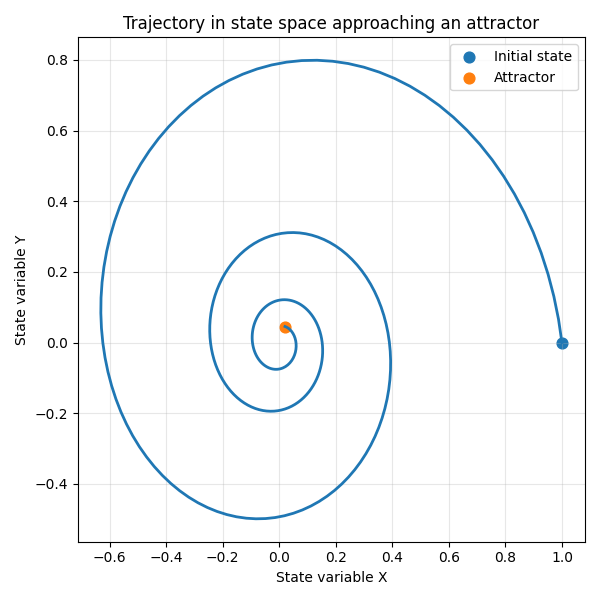
(Generated by the following illustrative Python code.)
import numpy as np
import matplotlib.pyplot as plt

# Simulated state-space trajectory approaching an attractor
t = np.linspace(0, 10, 300)

# State variables (toy non-equilibrium relaxation)
X = np.exp(-0.3 * t) * np.cos(2 * t)
Y = np.exp(-0.3 * t) * np.sin(2 * t)

plt.figure(figsize=(6, 6))
plt.plot(X, Y, lw=2)
plt.scatter(X[0], Y[0], s=60, label="Initial state")
plt.scatter(X[-1], Y[-1], s=60, label="Attractor")

plt.xlabel("State variable X")
plt.ylabel("State variable Y")
plt.title("Trajectory in state space approaching an attractor")
plt.legend()
plt.grid(alpha=0.3)
plt.tight_layout()
plt.show()
Closing thought
When data consistently choose a direction, the most economical explanation is not always a new force.
Sometimes, the system is simply telling us where equilibrium lies.
Next: Attractors, entropy, and the arrow of time in data space
Previous: When effective forces emerge from geometry
All Notes : Conceptual and Interpretational Notes